Sunday, 28 August 2016

salam

حضرت ابوذر رضی اللہ تعالیٰ عنہ سے روایت ہے کہ رسول اللہ صلی اللہ علیہ وآلہ وسلم نے فرمایا جس نے اجازت ملنے سے پہلے پردہ اٹھا کر کسی کے گھر میں نظر ڈالی گویا کہ اس نے گھر کی چھپی ہوئی چیز دیکھ لی اور اس نے ایسا کام کیا جو اس کے لئے حلال نہیں تھا۔ پھر اگر اندر جھانکتے وقت سامنے کوئی اس کی آنکھیں پھوڑ دیتا تو میں اس پر کچھ نہ کہتا (یعنی بدلہ نہ دلاتا) اور اگر کوئی شخص کسی ایسے دروازے کے سامنے گزرا جس پر پردہ نہیں تھا اور وہ بند بھی نہیں تھا پھر اس کی گھر والوں پر نظر پڑ گئی تو اس میں اس کی کوئی غلطی نہیں بلکہ گھر والوں کی غلطی ہے۔
عَنْ أَبِي ذَرٍّ قَالَ قَالَ رَسُولُ اللَّهِ صَلَّی اللَّهُ عَلَيْهِ وَسَلَّمَ مَنْ کَشَفَ سِتْرًا فَأَدْخَلَ بَصَرَهُ فِي الْبَيْتِ قَبْلَ أَنْ يُؤْذَنَ لَهُ فَرَأَی عَوْرَةَ أَهْلِهِ فَقَدْ أَتَی حَدًّا لَا يَحِلُّ لَهُ أَنْ يَأْتِيَهُ لَوْ أَنَّهُ حِينَ أَدْخَلَ بَصَرَهُ اسْتَقْبَلَهُ رَجُلٌ فَفَقَأَ عَيْنَيْهِ مَا عَيَّرْتُ عَلَيْهِ وَإِنْ مَرَّ الرَّجُلُ عَلَی بَابٍ لَا سِتْرَ لَهُ غَيْرِ مُغْلَقٍ فَنَظَرَ فَلَا خَطِيئَةَ عَلَيْهِ إِنَّمَا الْخَطِيئَةُ عَلَی أَهْلِ الْبَيْتِ

Friday, 26 August 2016

شہادت کے تصور میں تبدیلی

شہادت کے تصور میں تبدیلی
اسلام کے ابتدائی دور میں شہادت کا یہی تصور تها - اس زمانے میں شہادت کا لفظ گواہی کے لیے استعمال هوتا تها - جہاں تک اللہ کے راستے میں جان دینے کا معاملہ ہے ، اس کے لیے معروف لغوی لفظ #قتل استعمال هوتا تها - جیسا کہ قرآن میں آیا ہے : یعنی اور جو لوگ اللہ کہ راه قتل کیے جائیں ان کو #مرده مت کہو - اس آیت کے مطابق ، اللہ کے راستے جان دینے والے کو مقتول فی سبیل اللہ کہا جائے گا -
ایسے شخص کا اجر اللہ کے یہاں بلاشبہ بہت بڑا ہے - لیکن انسانی زبان میں اس کا ذکر هو گا تو اس کو مقتول فی سبیل اللہ کہا جائے گا - رسول اللہ صلی اللہ علیہ وسلم کے زمانے میں ہجرت کے تیسرے سال غزوه احد پیش آیا -
اس #جنگ میں صحابہ سے ستر آدمی مارے گئے - صحیح البخاری میں اس کا ذکر ان الفاظ کے ساته آیا ہے : یعنی حضرت انس بن مالک کہتے ہیں کہ احد کے دن اصحاب رسول میں سے ستر آدمی قتل هوئے -( صحیح البخاری ، 4078)
رسول اللہ کے بعد صحابہ اور تابعین کا زمانہ #اسلام میں مستند زمانہ سمجها جاتا ہے - اس زمانے میں یہی طریقہ رائج تها - بعد کے زمانے میں دهیرے دهیرے ایسا هوا کہ جس طرح دوسری تعلیمات میں تبدیلی آئی ، اسی طرح شہادت کی اصطلاح میں بهی تبدیلی آئی - یہاں تک کہ دهیرے دهیرے یہ حال هوا کہ شہادت بمعنی دعوت کا تصور امت کے ذہن سے حذف هو گیا - اس کے بجائے ، #شہادت اور #شہید کا لفظ جانی قربانی کے معنی میں استعمال هونے لگا -
بعد کے زمانے میں یہ رواج عام هو گیا کہ اس قسم کے افراد کے نام کے ساته شہید کا لفظ شامل کیا جانے لگا - مثلا حسن البنا شہید ، سید قطب شہید ، سید احمد شہید ، شاه اسماعیل شہید ، وغیره - اصحابہ رسول میں بہت سے لوگوں کے ساته جانی قربانی کا یہ واقعہ پیش آیا لیکن کسی کے نام کے ساته شہید کا لفظ شامل نہیں کیا گیا - مثلا عمر بن الخطاب شہید ، عثمان بن عفان شہید ، علی ابن ابی طالب شہید ، سعد بن معاذ شہید ، وغیره - صحابہ کا نام ہمیشہ ان کے آبائی نام کے ساته لکها اور بولا گیا ، نہ کہ شہید کے اضافے کے ساته - جیسا کہ بعد کے زمانے میں رائج هوا - چنانچہ محدث البخاری نے اپنی کتاب میں اس نوعیت کی کچهہ روایات کے اوپر یہ باب قائم کیا ہے : باب لا یقول فلاں شهید (کتاب الجہاد والسیر)
یہ بات ساده بات نہیں ہے بلکہ اسلام کے ایک اہم اصول پر مبنی ہے - وه یہ کہ لوگوں کو ان کے آبائی نام کے ساته پکارا جائے : یعنی ان کو ان کی آبائی نسبت سے پکارو ، یہ اللہ کے نزدیک زیاده منصفانہ بات ہے (33:5) - نام کے ساته شہید یا اس طریقے کے دوسرے الفاظ کا اضافہ کرنا ، اشخاص کے بارے میں غیر واقع ذہن بنانے والا عمل ہے - یہ طریقہ اسلام آداب کے مطابق نہیں -
شہادت اور شہید کے معاملے میں یہ غیر اسلامی طریقہ موجوده زمانے میں اپنی آخری حد پر پہنچ گیا - موجوده زمانے میں مسلمانوں کے درمیان تشدد کا جو طریقہ رائج هوا ، اس کا اصل سبب یہی ہے - جو لوگ اس متشددانہ عمل میں ہلاک هوتے ہیں ، ان کو بطور خود شہید اور شہداء کا ٹائٹل دیا جاتا ہے - اور یہ دعوی کیا جاتا ہے کہ یہ وه لوگ ہیں جو مرنے کے بعد فورا جنت میں داخل هو گئے -
یہ معاملہ اپنی عمومی صورت میں نوآبادیات کے دور میں رائج هوا - اس دور میں مغربی قوموں نے مسلم علاقوں پر غلبہ حاصل کر لیا - اس کے بعد اس دور کے مسلم مقررین اور محررین کی غلط رہنمائی کے نتیجے میں مسلمانوں کے اندر عام طور پر ان کے خلاف شدید ردعمل پیدا هو گیا - یہ ردعمل پہلے نفرت کی شکل میں جاری هوا - اس کے بعد بتدریج اس نے تشدد کی صورت اختیار کرلی -
اس متشددانہ عمل کو مقدس بنانے کے لیے کہا گیا کہ جو لوگ اس مقابلے میں مارے جائیں ، وه شہید هوں گے ، اور بلا حساب کتاب فورا جنت میں داخل هو جائیں گے - یہ بلاشبہ ایک خود ساختہ مسئلہ تها ، جس کا قرآن و حدیث سے کوئی تعلق نہیں - دوسری قوموں کے خلاف اس منفی ردعمل کی آخری تباه کن صورت وه ہے جو موجوده زمانے میں خودکش بمباری کی صورت میں ظاہر هوئی - اس خودکش بمباری کو مقدس بنانے کے لیے کچهہ علماء کی طرف سے غلط طور پر اس کو استشہاد (طلب شہادت) کا ٹائٹل دے دیا گیا -
اب حال یہ ہے کہ لوگ بڑی تعداد میں شہادت کے نام پر اپنی جانیں دے رہے ہیں - لیکن شہادت کا اصل کام ، #دعوت الی اللہ کو انجام دینے کی تڑپ کسی کے اندر نہیں ، نہ مسلم علماء کے اندر ، نہ مسلم عوام کے اندر - شہادت کے اس خود ساختہ تصور کے تحت وه جن لوگوں پر حملے کرتے ہیں ، وه ان کے لیے مدعو کی حیثیت رکهتے ہیں - اور مدعو کو ہلاک کرنا اسلام میں سرے سے جائز ہی نہیں -
الرسالہ ، جون ، 2015
فریضہ شہادت

مشابہت

رسول اللہ صلی اللہ علیہ وآلہ وسلم نے فرمایا جس نے ہمارے علاوہ کسی اور کی #مشابہتاختیار کی اس کا ہم سے کوئی تعلق نہیں۔ #یہود و #نصاری کی مشابہت اختیار نہ کرو۔ 
أَنَّ رَسُولَ اللَّهِ صَلَّی اللَّهُ عَلَيْهِ وَسَلَّمَ قَالَ لَيْسَ مِنَّا مَنْ تَشَبَّهَ بِغَيْرِنَا لَا تَشَبَّهُوا بِالْيَهُودِ وَلَا بِالنَّصَارَی
جامع #ترمذی ۔ جلد دوم ۔ #حدیث 606

Tuesday, 23 August 2016

Ibn Hajar reported: Ash-Shafi’ee, may Allah have mercy on him, said, “Innovations are of two kinds: praiseworthy and blameworthy. Whatever agrees with the Sunnah is praiseworthy and whatever differs from it is blameworthy.”
In another narration, Ash-Shafi’ee said, “Newly invented matters are of two types. Whatever is invented that differs from the Book, the Sunnah, the reports, and the consensus, then this is called an innovation of misguidance. Whatever goodness is invented that does not differ in any way from those, then this is called an innovation that is not blameworthy.”
Source: Fath ul-Bari 6849
عن ابن حجر قَالَ الشَّافِعِيُّ الْبِدْعَةُ بِدْعَتَانِ مَحْمُودَةٌ وَمَذْمُومَةٌ فَمَا وَافَقَ السُّنَّةَ فَهُوَ مَحْمُودٌ وَمَا خَالَفَهَا فَهُوَ مَذْمُومٌ
عَنِ الشَّافِعِيِّ أَيْضًا قَالَ الْمُحْدَثَاتُ ضَرْبَانِ مَا أُحْدِثُ يُخَالِفُ كِتَابًا أَوْ سُنَّةً أَوْ أَثَرًا أَوْ إِجْمَاعًا فَهَذِهِ بِدْعَةُ الضَّلَالِ وَمَا أُحْدِثُ مِنَ الْخَيْرِ لَا يُخَالِفُ شَيْئًا مِنْ ذَلِكَ فَهَذِهِ مُحْدَثَةٌ غَيْرُ مَذْمُومَةٍ
6849 فتح الباري شرح صحيح البخاري كِتَاب الِاعْتِصَامِ بِالْكِتَابِ وَالسُّنَّةِ المحدثات
Narrated Abu Huraira (Radi-Allahu 'anhu):

Allah's Apostle (Sallallahu 'Alaihi Wa Sallam) said, "The congregational
prayer of anyone amongst you is more than twenty (five or twenty seven)
times in reward than his prayer in the market or in his house, for if he
performs ablution completely and then goes to the masjid with the sole
intention of performing the prayer, and nothing urges him to proceed to the
masjid except the prayer, then, on every step which he takes towards the
masjid, he will be raised one degree or one of his sins will be forgiven.
The angels will keep on asking Allah's forgiveness and blessings for
everyone of you so long as he keeps sitting at his praying place. The
angels will say, 'O Allah, bless him! O Allah, be merciful to him!' as long
as he does not do Hadath or a thing which gives trouble to the other." The
Prophet (Sallallahu 'Alaihi Wa Sallam) further said, "One is regarded in
prayer so long as one is waiting for the prayer."

Bukhari Vol. 3 : No. 330

Monday, 22 August 2016

Sunan al-Tirmidhī 3358

Abu Huraira reported: The Messenger of Allah, peace and blessings be upon him, said, “Verily, the first thing a servant will be asked about on the Day of Resurrection will be his blessings. It will be said to him: Did We not give you health in your body and cool water to drink?
Source: Sunan al-Tirmidhī 3358
Grade: Sahih (authentic) according to Al-Albani
عَنْ أَبِي هُرَيْرَةَ قَالَ قَالَ رَسُولُ اللَّهِ صَلَّى اللَّهُ عَلَيْهِ وَسَلَّمَ إِنَّ أَوَّلَ مَا يُسْأَلُ عَنْهُ يَوْمَ الْقِيَامَةِ يَعْنِي الْعَبْدَ مِنْ النَّعِيمِ أَنْ يُقَالَ لَهُ أَلَمْ نُصِحَّ لَكَ جِسْمَكَ وَنُرْوِيَكَ مِنْ الْمَاءِ الْبَارِدِ
3358 سنن الترمذي كتاب تفسير القرآن باب ومن سورة ألهاكم التكاثر
3358 المحدث الألباني خلاصة حكم المحدث صحيح في صحيح الترمذي

Thursday, 18 August 2016

Bukhari Vol. 3 : No. 576

Narrated Hudhaifa (Radi-Allahu 'anhu):

I heard the Prophet (Sallallahu 'Alaihi Wa Sallam) saying, "Once a man died
and was asked, 'What did you use to say (or do) (in your life time)?' He
replied, 'I was a business-man and used to give time to the rich to repay
his debt and (used to) deduct part of the debt of the poor.' So he was
forgiven (his sins.)" Abu Masud said, "I heard the same (Hadith) from the
Prophet."

Bukhari Vol. 3 : No. 576

Wednesday, 22 June 2016

Islam and Honor Killings

At present, there are numerous labels of negative connotations being associated with Islam. People all over the world fail to understand that culture and Islam are different in the Muslim population and the different acts which Muslims at present undertake because of their social or cultural constraints have nothing to do with Islam.
Although Islam in itself has the best culture, but Muslims at present have culture different from Islam but the west considers their culture as an Islamic culture. This notion is wrong and has nothing but biased bad name to Islam. One of such cultural phenomenon that has been defaming Islam is the act of honor-killing.
Islam-and-Honor-Killings copy
All over the Muslim world there are people who kill women just because of the suspicion or even a proved fact that the women has defamed them by committing adultery. Although there have been very few cases in which such an action has been proved, however, still the figure of honor killing remains high. One must understand that honor killing has nothing to do with Islam and it is purely an act that is against the teaching of Islam and has no roots in Islam whatsoever. The lines below discuss how Islam views killing in general and honor killing in particular.
Allah Almighty says in Quran:
Killings in Islam
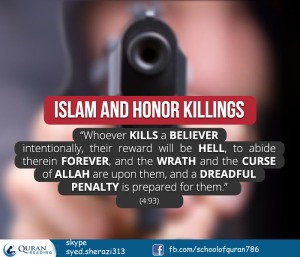
“Whoever kills a believer intentionally, their reward will be Hell, to abide therein forever, and the wrath and the curse of Allah are upon them, and a dreadful penalty is prepared for them.” (4:93)
From this ayah of Quran it is obvious that there is no room for killing a believer in Islam. Whoever intentionally kills a believer, the only reward left for him or her is the life of hell in the hereafter. Therefore, intentional killing of a believer in Islam is one of the gravest sins that a person can commit.
Further to killing Islam discusses the sanctity of human life as well. In Islam human life is one of the most sacred things and a Muslim is to care for life of others and make sure that no life is lost. Allah Almighty says in Quran:
Honor killing in Islam
“On that account: We ordained for the Children of Israel that if anyone kills a person – unless it be for murder or for spreading mischief in the land – it would be as if they killed all people. And if anyone saved a life, it would be as if they saved the life of all people.” (5:32)
From this ayah of Quran it again becomes clear that human life is sacred. One cannot kill a human unless the person being killed is spreading mischief in the world or life for life. Other than that saving  a life is saving humanity and killing one is killing humanity.
The possible hadith that the illiterate and Muslims with lack of knowledge use to justify the act of honor killing is as follows where Prophet Muhammad (PBUH) explained the situations when shedding of blood is allowed by saying:
“It is not permissible to shed the blood of a Muslim who bears witness that there is no god but Allah and that I am the Messenger of Allah except in three cases: a life for a life (murder), zina of one who is previously married (adultery), and the one who changes his religion and forsakes the jamaa’ah.” (Bukhari)
From the ayah one can find that killing an adulterer who is married is allowed in Islam. This is the justification which the people have for honor killing in a Muslim society. However, they don’t realize the fact that this hadith gives a general concept and the scholars have further discussed the conditions in which it is allowed.  The conditions are two:
  1. Firstly, the adulterer has to be previously married. It means that he or she would have had intercourse in a marriage, he or she is an adult, and in addition to being mentally sane they are free born as well. Therefore, those who are not married are not to be killed in the light of this hadith.
  2. The second condition for killing an adulterer is that there should be four male witnesses who would witness the meeting of the private parts of both the individuals involved in adultery. Moreover, this adultery is to be committed out of consent for the punishment to be valid.
  3. If it is supposed that the conditions are met, even then an individual does not have any right to kill the other, rather the power of punishment is to be given to the state justice system who would give an Islamic judgment on the matter.
From the mentioned hadiths it is clear that the only killing allowed pertaining to defaming of honor is the killing of an adulterer who is or has been previously married. It means that killing of women who are not married is not allowed in Islam, moreover, the one thing that most people forget is that this rule and law is equally applicable on men as well. Moreover, if the woman is found guilty of the crime, even then an individual does not have any right to kill another person or woman in particular.
  1. Usually in honor killing unmarried women are killed. The above discussion shows that even if proved, an unmarried woman cannot be killed for adultery. Therefore, whoever do it don’t do it from Islam rather they do it from their social or cultural roots.
  2. The above discussion also shows that mere accusation on a married woman pertaining to adultery is not sufficient enough for killing her. Rather, it is only allowed when there are witnesses available that testify to the adultery taking place and that too not out of forcefulness but out of consent.
  3. Most importantly the discussion shows that if there is to be honor killing then men were to be treated in the same was as are women because the ruling for killing a fornicator that Islam gives is free from gender biasness and both the genders are to be held equally responsible for the act and its consequences.

Monday, 20 June 2016

Islam And Different Types Of Health

The common notion about Islam is that it is a religion that commends its followers to be a servant to God only and live the worldly life in a way that it elevates the spirit of the person and helps gain religious benefits. Although this notion is a part of Islam but not the whole Islam, the whole Islam is complete in every sense and has instructions regarding each aspect of life.
islamandhealth copy
Islam gives a complete and thorough framework of life, by following which a person can live life in the best way possible both from worldly and religious perspective. With every matter of life Islam gives a holistic and a specific solution. Therefore, a follower of Islam has all the instructions available and all he needs to do is to follow them.
Pertaining to general health, Islam takes a holistic approach and provides remedy and instructions regarding spiritual, emotional and physical health. The lines below give the perspective of Islam on the three levels of general health.
1. Spiritual Health:
Spiritual health is important in Islam and one of the key objectives of being a Muslim is to improve the health of the spirit. On a general level the spiritual health depends upon the kind of believe a person has and based on that believe how does a person respond to afflictions and adversities. The better the response of a person, the better is the spiritual health. The hadith of Prophet Muhammad (PBUH) says:
“Indeed amazing are the affairs of a believer! They are all for his benefit. If he is granted ease then he is thankful, and this is good for him. And if he is afflicted with a hardship, he perseveres, and this is good for him.” (Muslim)
This hadith shows the kind of belief a Muslim possess pertaining to the ease and difficulties in life. A Muslim who believes that all the eases and hardship is from Allah Almighty and rejuvenates and perseveres in the respective cases is the one whose spirit is healthy.
Further to the health of spirit, it is the external afflictions and sickness that puts this particular health to its test. In this regard also the hadith of Prophet (PBUH) gives the best model:
“Whenever a Muslim is afflicted by harm from sickness or other matters, God will expiate his sins, like leaves drop from a tree.” (Muslim and Bukhari)
From this hadith, it is obvious that all the physical afflictions sent by God help shed sins. All a Muslim needs to do is persevere and the afflictions become a blessing in disguise that remove all the sins associated with the soul of person, thus making spiritual health better.
2. Emotional Health:
In addition to the spiritual health, the second level of health that Islam addresses is the emotional health. The kind of emotions a person has has a great impact on the way a person lives life. Positive emotions bread a righteous and virtuous life, while negative emotions bring the vices of a person to the surface.
The emotion part of the health has a lot to do with the heart, if the heart is at peace, then all the adversities would seem like blessings as discussed earlier, and if the heart is not at its right place, then even the joyful moments would lead to a life that is transgressing and not commended by Allah Almighty.
In Quran, Allah Almighty says:
“O mankind! There has come to you a good advice from your Lord (i.e. the Quran), and healing for that which is in your hearts.” (10:57)
In this ayah of Quran, it is evident that Quran is solution to the problems of heart, thus reading, listening and understanding of Quran helps better the emotional health of a person. The more the heart of a person is grateful, peaceful and obliged better will be its health and more blessings would it receive from Allah Almighty, as He says in Quran:
“And when your Lord proclaimed, “If you give thanks, I will give you more; but if you are thankless, lo! My punishment is dire.” (14:7)
Hence, the emotional health of a person increases when the heart is content, obliged and thankful to all the blessings of Allah Almighty.
3. Physical Health:
The emphasis of Islam on physical health is another aspect of Islam about which people are oblivious. Islam commends its followers to pay attention towards their health and take good care of it. Pertaining to physical health, Islam addresses both the diet and exercise aspects of health. Allah Almighty says in Quran:
“O mankind, eat from whatever is on earth (that is) lawful and good and do not follow the footsteps of Satan. Indeed he is to you a clear enemy.” (2:168)
In this ayah, it is clear that Allah Almighty has allowed Muslims to eat whatever they want to eat in this world, except for the foods that are unlawful and the ones that take a person on the footsteps of Satan. Regarding the forbidden foods besides the intoxicants, Allah Almighty says in Quran:
“Forbidden to you (for food) are: dead meat, blood, the flesh of swine, and that on which hath been invoked the name of other than Allah, that which hath been killed by strangling, or by a violent blow, or by a headlong fall, or by being gored to death; that which hath been (partly) eaten by a wild animal; unless ye are able to slaughter it (in due form); that which is sacrificed on stone (altars); (forbidden) also is the division (of meat) by raffling with arrows: that is impiety…..” (5:3)
In this ayah, Allah Almighty has clearly described the foods that are unlawful for a Muslim and the eating of which is forbidden, all the other foods are lawful to Muslims and he can consume them in the way he likes.
Pertaining to the exercise part of physical health, Islam encourages its followers to indulge in sports and physical activities that improve the health and strength of the body. Prophet Muhammad (PBUH) said in one of His hadiths:
“Any Action without the remembrance of God is either a diversion or heedlessness excepting four acts: Walking from target to target (during archery practice), training a horse, playing with one’s family, and learning to swim.” (Tabarani)
From this hadith it is evident that Prophet (PBUH) encourages playing sports that are healthy for the body.
Conclusion:
In short, Islam like its own completeness and comprehensiveness addresses all the matters of life with on a complete and comprehensive level. For Islam, the spiritual, emotional, and physical health all are important and the presence of all makes a healthy believer and Muslim.

Wednesday, 1 June 2016

Qurani Sorton ka Khulasa by Syed Abdulwahab Sherazi

قرآنی سورتوں کا مختصر خلاصہ۔ رائے ضرور دیں۔       

Saturday, 28 May 2016

Islamic Dress Code for Men – Major Elements to Consider

Although one needs to see the inner beauty and character of a person to reach some judgment about the person, however, this does not mean that one should ignore the physical appearance of a person at all. The way a person looks from the outside is that gives the first impression about what a person is like or from which place or school of thought a person belongs to.
When it comes to physical appearance in general and dressing in particular, Islam gives clear instructions about how both the genders dress, so that they do not break the rules of Islam and in their dressing there is modesty. In addition to women, Islam has also spoken about the way Muslim males should dress.
Dressing-for-Men-in-Islam copy

The lines below give the general Islamic instructions pertaining to male dressing.
Avoid The Haram Elements:
Although in Islam there is great freedom to Muslim in terms of wearing the kind of dress they like to wear, however, there are some limits which should not be crossed by a male Muslim. In this regard, a Muslim is not supposed to wear gold and silk in part of dressing or the whole attire. Regarding this, Prophet Muhammad (PBUH) said in His hadith:
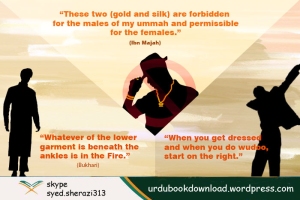
“These two (gold and silk) are forbidden for the males of my ummah and permissible for the females.” (Ibn Majah)
From this hadith of Prophet Muhammad (PBUH) it is clear that both silk and gold are Haram and impermissible to Muslim men, therefore, they need to avoid the dressing which includes these two elements. If these two elements are present in the dressing, then the dressing will be Haram and against the teaching of Islam. Other than that, Muslims can wear any dress made out of skin of animals, their fur or the stuff made out of them.
How-to-Dress-Like-a-Muslim-Man copy

Avoid See-through Dresses:
The second thing that Muslim men need to avoid in their dressing is the see through dresses. When the dresses are see through the ultimate result of it wall will be people being able to see the Aurah (the mandatory covering region). Hence when the Aurah of a person becomes visible, it is counted in the category of sin. Therefore, in order to avoid any such situation, Muslim men should refrain from wearing see through garments, until and unless they are wearing some kind of undergarment that protects their Aurah.
Avoid Imitation:
It is narrated that once Prophet Muhammad (PBUH) saw Hazrat Ali wearing two garments that were dyed with safflower, seeing which He said:
“These are the garments of Kuffar, do not wear them.” (Muslim)
From this ayah it becomes clear that a Muslim is not supposed to copy the non-Muslims when it comes to wearing of dress.  The dress of a person is a part of his identity, therefore, when one starts copying the non-Muslims in dressing, it means that the person is prone to accepting their values as well and losing his own Muslim identity. Therefore, for this very reason, a Muslim must avoid imitating the non-Muslims with regards to the type and kind of dressing worn.
Avoid Women Dressing:
In addition to refraining from gold and silk, Islam also instructs its followers to avoid dressing like women. It is quite evident that there is a difference between the way women dress and the way men dress, therefore, to keep things simple and to avoid any kind of awkward situation, a Muslim must refrain from dressing like women. In this regard, Prophet Muhammad (PBUH) said in His hadith:
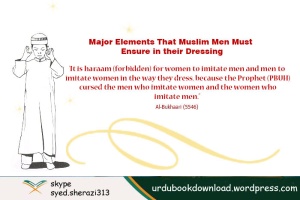
“Cursed be the men who imitate women and the women who imitate men.” (Bukhari)
Therefore, men must avoid imitating women in dressing and similarly women must avoid imitating men in their dressing. Checkout the Islamic dress code for Muslim Women.
Start From The Right:
In addition to the apparel, Prophet Muhammad (PBUH) has also spoken about the way a Muslim should start wearing a dress. In addition to starting wearing the dress with Bismillah (In the name of Allah) a Muslim must start wearing the dress from the right side. Regarding this, Prophet (PBUH) said in a hadith:
“When you get dressed and when you do wudoo, start on the right.” (Abu Dawood)
Hence, a Muslim must try wearing the dress with the right side first and then moving on to the left part of the attire.
Avoid Arrogance:
In the world of today, the dressing of a person has become a status symbol. Although Islam emphasizes on wearing clean and pleasant clothes and having modest dressing, however, it condemns the element of arrogance associated with it. Prophet (PBUH) said:
“No one will enter Paradise in whose heart is a mustard-seed of arrogance.”
The companion asked:
“What if a man likes his clothes to look nice and his shoes to look nice?”
Prophet (PBUH) replied:
“Allah is beautiful and loves beauty; arrogance means rejecting the truth and looking down on people.” (Muslim)
Therefore, if the dressing is worn with the objective of making oneself superior and to make other people think that they are inferior, then it is strongly prohibited in Islam, whereas, if it done for the purpose of looking beautiful, whilst being modest, then such dressing is allowed in Islam.
Above Ankle:
Another important thing that Muslim men need to ensure in their dressing is the fact that their lower garment should be above their ankles. It means that the pants part of the dress should be above ankles. In this regard, Prophet Muhammad (PBUH) said:
“Whatever of the lower garment is beneath the ankles is in the Fire.” (Bukhari)
This hadith of Prophet (PBUH) is specific to males, therefore, it is imperative that Muslim men avoid any such garment that hangs loose below the ankle length.
Conclusion:
In a nutshell, the aforementioned are the major elements that Muslim men must ensure in their dressing. The presence of these elements gives them a Muslim identity and makes sure that they are as Muslim in their appearance as they are at their hearts.

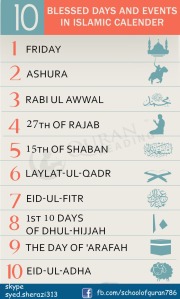
10 Blessed Days And Events In Islamic Calender

Every religion has some specific occasions, which have special value and importance in the lives of its followers, like Christians celebrate Christmas and observe Easter, Hindus rejoice Diwali and Holi. Recognizing and taking part in these events enhance one`s knowledge and implication of its religious ideologies and conviction.
The Islamic Calendar also contains numerous days of great importance representing the deep lying allusions attached to their occurrences in the earlier history of our religion. Most of these happenings are mentioned in the Holy Quran and Allah SWT Himself has explained their worth.
Islamic-Events-And-Blessed-Days copy
In this post by QuranReading.com, we will explore the most significant and blessed Islamic days and instances in the lives of Muslims:
1)      Friday
Friday is considered as the most honored and hallowed day of week in the religion of peace. The Holy Prophet (PBUH) has illustrated its worth in the following wording:
“The best day on which the sun rises is Friday. It is the day Adam was created. It is the day when Adam entered the Heavenly Gardens, the day when he was expelled from it and also the day he died. Friday is the day on which the Day of Resurrection will take place.” (Muslim)
All the happenings that are mentioned in this Hadith give the indication of great value of this day. Its significance even increases due to grand congregational prayer held during its daytime, which is called Salat e Jumu`ah (The Friday Prayers). During this Namaz, the Imam of the masjid (mosque) gives a special address known as the Friday Sermon, which is a great source of getting wisdom and spirituality. Its enormous position in the lives of us Muslims is evident from the fact that the Almighty God has separately mentioned it in the Holy Quran, which contains a separate Surah (chapter) by the name of this day, i.e. Jumu`ah (Friday).
islamic calender
“O you, who have believed, when [the adhan] is called for the prayer on the day of Jumu’ah [Friday], then proceed to the remembrance of Allah and leave trade. That is better for you, if you only knew.” [Quran, 62:9]
It means that it has much wider appeal in a sense that God, the Exalted has directed us to leave every business and move towards answer call to prayer. It is also the same day on which the very first verses of the Sanctified Scripture were revealed to the Messenger (PBUH) of Allah.
blessed days
“….. This day I have perfected for you your religion and completed My favor upon you and have approved for you Islam as religion….” [Quran, 5: 3]
By reading this Ayah, one can know that Friday is indeed the best day to seek Allah`s mercy and blessings as on this very day, Quran which is the guiding principle for us Muslims, was first disclosed on the Holy Prophet (PBUH). Also, one can recite certain Quranic chapters like Surah Kahf on this day to be able to get the Almighty`s protection and blessings.
2)      Ashura
Observed on 10th of Moharram (first Islamic Year), this day has two major implications. First, it serves as a means of remembrance of migration of Hazrat Musa/Moses (A.S) from Egypt to save His followers from the tyranny and oppression of Firaon (Pharaoh). We Muslims fulfill the sunnah of Musa (A.S) Who fasted on this day to thanks Allah SWT for saving them on this day.
Abu Hurrerah (R.A) reported:
“I asked the Prophet: ‘Which Prayer is the best after the obligatory Prayers?’ He said: ‘Prayer during the mid of the night.’ I asked: ‘Which fasting is the best after that of Ramadan?’ He said, ‘the month of Allah that you call Muharram’” (Ahmad, Muslim, and Abu Dawwud).
It means that fasting on this day is closer to doing so in the Holy month of Ramadan. Second great factor that is associated with this day is that it refers to the heartrending death of the Prophet’s grandson, Hussain (R.A) at the hands of the Umayyad ruler, Yazid. It reminds us of the great significance of the action of standing firm one the word of righteousness against the tyrant and non-believing rulers.
3)      Rabi ul Awwal (Prophet`s PBUH Birth)
This is the month in which Muslims received the greatest blessing from Allah SWT, as the last Prophet, Hazrat Muhammad (PBUH) was born in it, though there is no general consensus among the Muslim sects related to the exact date of His birth. The fact remains that this wonderful month has that special day, which proved to be the stepping stone in revolutionizing the lives of millions of people. Muslims all over the world commemorate during this blessed month and take the opportunity to show their love and gratitude towards the Holy Prophet (PBUH).
4)      27th of Rajab
One of four sacred months of Islamic Calendar (rest of three are Zul Qa`dah, Zul Hajj and Muharram), it has general meaning of ‘to respect” and is regarded as the Month of Allah by the Holy Prophet (PBUH). Generally, it is associated with fasting for the sake of the Most Merciful. Rasulullah (PBUH) was quoted by Abu Hurrehah (R.A) as fasting throughout this month, besides Ramadan. Specifically, it contains a sacred night, i.e. 27th of Rajab, on which the Messenger (PBUH)of God was taken by Jibrael (A.S), the Angel of Allah, first on “Isra” (journey) from Makkah to Jerusalem where He (PBUH) lead the prayers with all the previous Prophets behind Him. Then, He went on “Mer`aj” (elevator) from Jerusalem to the heavens, till He got the honor of meeting with Allah SWT. From there, Muslims were directed to offer Salah daily which is the most useful way to get closer to the Almighty, and results in His forgiveness.
5)      15th of Shaban
Commonly known as the month of Prophet Muhammad (PBUH), it contains a night, i.e. 15th of Shaban, in which Muslims throughout the world ask for Allah`s clemency and His blessings by spending the whole night in His worship and reciting the Holy Quran. Although the topic of celebrating on this particular nighttime is a disputed one among the Muslim sects, but still it has the greater implication in terms of getting the Almighty`s mercy.
“In the fifteenth night of Shaban, Allah manifests and forgives all His creation except for the Mushrik (idolater) and the spiteful.” (Ibn Majah)
So, it means that the true believers of the religion of peace, when they expend the entire night in Allah`s remembrance and His pardon, the Almighty Lord responds to their plea and comfort their hearts and souls by forgiving their past sins.
6)      Laylat-ul-Qadr
The Holy month of Ramadan, which on one hand, provides us Muslims with the opportunity to fast for the sake of Allah Almighty, and earns us His compassion and good tidings. On the other hand, it also consists of an extraordinary and highly rewarding night which involves constant memory of the Creator of the universe through prayers and Quran reading. The great worth of this very time of the dark is discussed in the Holy Quran, where there is a separate Surah (chapter), named as Surat-ul-Qadr describing it like:
“Indeed, We sent the Qur’an down during the Night of Decree. And what can make you know what is the Night of Decree? The Night of Decree is better than a thousand months. The angels and the Spirit descend therein by permission of their Lord for every matter. Peace it is until the emergence of dawn.” [Quran, 97: 1-5]
So, it is the night in which Furqan e Hameed was revealed on the Prophet (PBUH) for the first time, which is a great guiding source for Muslims in every walk of life. This single night is regarded as better than thousand months, which shows the great returns from the Almighty as a result of praying in it. Hazrat Aisha (R.A) stated that the Holy Prophet (PBUH) said,
“Look for Lailat-Ul-Qadr in the odd nights of the last ten days of Ramadan.” (Bukhari)
It shows that there is no defined night for acquiring the blessings of the Most Gracious; instead one has to keep searching for it during the odd nights of the last part of Ramadan. Majority of Muslims all over the world fulfill Sunnat I`tikaf, spend their time in the mosque to worship and recite the Sacred Scripture, till they acquire the blissful night of Qadr (the Nighty of Power/destiny/value).
7)      Eid-ul-Fitr (Festival Followin Fasting During Ramadan)
After fasting for whole month of Ramadan, Muslims are blessed by the Almighty Lord with a celebration named Eid-ul-Fitr. A special prayer is offered in the mosque having similar sermon like that of found in the Salah of Jumu`ah, but is done after Fardh (obligatory) Rakats. It not only serves a festival to enjoy the blessings of Allah for three consecutive days but also a great source of meeting other family members, sharing happiness, inviting guests, giving charity, which in turn make us able to receive many of the bounties of the Most Beneficent.
8)      The First Ten Days of Dhul-Hijjah
The 12th and final month of the Islamic Calendar, called Dhul-Hijjah, is one of the most sacred months. Its literal meaning is “Possessor of the Pilgrimage”, which is because Hajj (grand pilgrimage) is performed by the Muslims on the 8th, 9th and 10th of this month. Its first ten days are highly revered and blissful. Ibn Abbas (R.A) narrated the Holy Prophet (PBUH) saying as:
“No good deeds done on other days are superior to those done on these (first ten days of Dhul Hijja).” Then some companions of the Prophet said, “Not even Jihad?” He replied, “Not even Jihad, except that of a man who does it by putting himself and his property in danger (for Allah’s sake) and does not return with any of those things.” (Bukhari)
The above mentioned Hadith shows that committing righteous actions during these first days have even more influence than other good deeds, even Jihad, which is itself one of the greatest things to do for Allah. The Messenger (PBUH) of the Almighty also used to fast during these days. One of the wivesof Muhammad (PBUH) said:
“Allah’s Messenger used to fast the [first] nine days of Dhul-Hijjah, the day of ‘Ashurah, and three days of each month.” (Abu Dawud)
So, the first days of this month are highly sanctified and venerated that they serve as means of awarding us with great rewards of Allah SWT.
9)      The Day of ‘Arafah
On 9th day of Dhul-Hijjah, the pilgrims gather around in the ground of Arafah for praying and seeking Allah`s mercy. Those who are not able to perform Hajj are advised to keep fasting on this day; however it is not necessary for the pilgrims to fast on this day because of their tough circumstances. Abu Qatadah (R.A) reported that the Messenger (PBUH) said:
“Fasting the Day of ‘Arafah expiates the sins of two years: past one and coming one. And fasting on the Day of ‘Aashuraa’ expiates the sins of the past year.” (Muslim)
This Hadith describes the spirit of fasting on this day for sake of the Almighty in terms of being forgiven the sins of previous and coming year. Aaishah (R.A) reported that the Messenger (PBUH) said:
“There is no day on which Allah frees people from the fire as He does on the Day of ‘Arafah. He comes close and then He boasts to His angels: ‘What are these people seeking?’” (Muslim)
It means that Allah SWT highly admires its servants who bow in front of Him, and seek His pardon, and He shows His gladness with His Angels about his fact as narrated in the above mentioned saying of the Holy Prophet (PBUH).
10)  The Ruling Of The Udhiyah (Sacrifice)
The word udhiyah means an animal from class of “an`aam” (camel, sheep, cow, goat). Muslims who have the capacity to have or buy such animals are ordered by the Almighty Lord to sacrifice animal in His way, and get His rewards. It has great importance as it opens the gates of blessings and mercy of the Gracious God, and results in easiness of matters as Hazrat Musa (Moses) (A.S), as directed by the Allah to slaughter a cow to be able to solve the mysterious murder. The Holy Quran repeatedly mentions about sacrificing in the way of God:
10 blessed days
Say, “Indeed, my prayer, my rites of sacrifice, my living and my dying are for Allah, Lord of the worlds.” [Quran, 6: 162]
This Ayah shows that sacrifice is done for sake of Allah SWT, as it is mentioned along with prayer. Anas (R.A) reported that the Messenger (PBUH) said:
“He who slaughtered before the prayer (of Eid) has only slaughtered for himself. But the one who did it after the prayer has indeed completed his sacrifice and conformed with the Sunnah of the Muslims.” (Bukhari)
The above stated Hadith tells about the right time of slaughtering the animal, i.e. doing it after the prayer of Eid-ul-Adha, which is obligatory to perform. The greater implication of this day is to keep the poor in mind, being aware of their poor condition, give them charity and divide the flesh of animal among them and be grateful to Allah for all His blessings.
These are 10 and the most important days and events that are found in the Islamic Calendar, which, unlike other religions, are not only meant for making merry or worshiping alone, but they are a complete package for keeping a balance between our worldly and eternal life by reviving the true essence of Islamic convictions.

Wikipedia

Search results